Golf Cart Wrap Colors and Finishes
Pair a bold or understated palette with gloss, matte, chrome or holo, then bring the look together with your roof, seats and wheels.
Golf Cart Wraps Team · Editorial team · · 13 min read · Updated Nov 21, 2026
Golf cart wrap colors never live on a blank white page. Every panel sits right beside your roof canopy, windshield tint, seats, wheels and frame trim. A navy and white wrap feels crisp and airy under a white roof, while the exact same graphics look darker and sportier next to matte black seats and black rims. Choosing those surrounding parts alongside your wrap keeps the entire cart looking planned.
Finish changes the mood just as quickly as color does. Gloss throws bright highlights across curved cowls, matte quiets glare so dark tones hold their shape, chrome reflects its surroundings like polished metal, and holographic shifts hue as you walk around the cart. Swap a clear windshield for dark tint and the upper half of the build immediately carries more visual weight.
Start with two or three colors you genuinely enjoy, then let AI turn a short description or reference photo into custom wrap artwork across your cart panels. Compare finishes live in 3D, coordinate all surrounding hardware parts, and review the unfolded wrap sheet before exporting your winner in HD.
Why Two or Three Colors Make a Stronger Cart
Two or three main colors give a golf cart an unmistakable identity from down the street or across a course. Follow the 60-30-10 visual split that works on almost every custom vehicle: about 60% dominant body color to set the mood, 30% secondary graphic shapes plus roof and seats, and 10% sharp accent color for striping, seat piping, logos or your family name.
Decide which surface should lead before picking secondary shades. Deep navy body panels with broad white waves read like a tailored coastal cruiser, while white panels with slim navy stripes feel lighter and brighter in afternoon sun. Adding a thin coral stripe brings warmth without competing against the big shapes, provided it stays inside that 10% accent budget.
Value contrast matters far more than color count. Soft gray text over a white wave fades out twenty feet away, whereas crisp white lettering over deep forest green stays readable from across a parking lot. Zoom the 3D view out to street distance and verify that the primary silhouette, personal lettering and panel edges remain cleanly separated.
Even an energetic botanical or geometric graphic stays sharp when its colors follow a clear hierarchy. Let the broadest color zones anchor the front cowl and long side skirts, keep fine lines away from tight curves, and repeat your accent color on both flanks so the cart reads as one unified build from every walking angle.
If your family cannot agree on a color family, test two completely different temperatures first: one cool palette built around navy or teal, and one warm palette built around olive, tan or coral. Seeing full panels on the 3D cart ends most debates immediately because owners react far more clearly to finished bodywork than to color names.
- Dominant body wrap base color60%
- Secondary graphics, roof and seats30%
- High-contrast accent, trim and lettering10%
Proportion target for balancing body wrap artwork, cart hardware and high-contrast accents.
Gloss, Matte, Chrome and Holographic Finishes
Gloss, matte, chrome and holographic finishes alter how light travels over rounded cowls and contoured side panels. Gloss creates wet, high-energy highlights that boost deep blues, bright reds and crisp whites. Matte diffuses daylight across every curve so olive greens, charcoal grays and satin blacks look tailored rather than shiny.
Watch how highlights move over a rounded front nose. In high gloss, a bright reflection band can run directly across fine script lettering or thin pinstripes if they sit too close to the upper hood ridge. Give important emblems generous breathing room and check both head-on and side three-quarter angles before locking in a gloss finish.
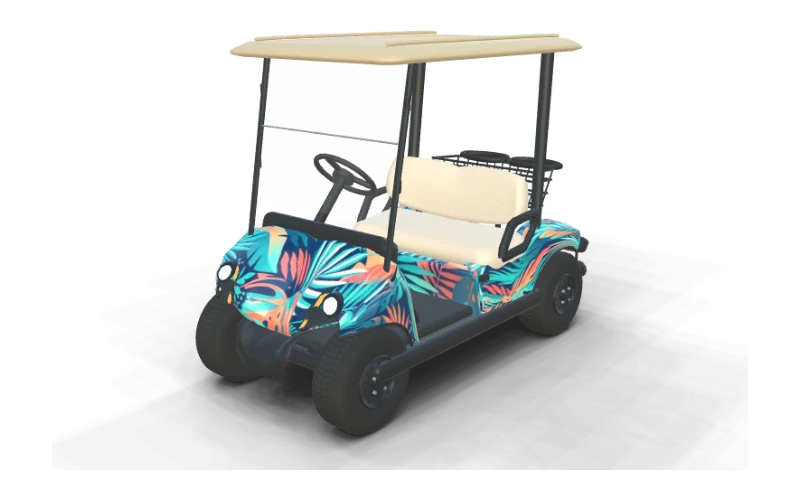
Chrome and holographic effects command immediate attention even over minimal artwork. Start with a disciplined dark base and let the reflective sheen accent bold geometric lines, a clean crest or racing stripes instead of cramming tiny textures onto every square inch. On a tropical or coastal sunset build, holographic accents deliver lively movement while clean negative space keeps the design readable.
Toggle all four finishes on the live 3D cart before changing a color palette you almost love. Watching studio reflections sweep across the panels often solves a layout faster than picking new colors. The table below pairs each finish with the themes and hardware colors that support it cleanly.
Think about where the cart spends most of its hours, too. Carts parked along sunny coastal drives or bright course cart paths reflect overhead sky heavily in gloss, making bright whites and cool blues look luminous. Under tree-lined neighborhood lanes and evening streetlights, matte darks paired with crisp light stripes hold stronger silhouette contrast.
| Finish | Glare and contrast | Themes that suit it | Hardware pairing |
|---|---|---|---|
| Gloss | Bright highlights boost saturation across curved cowls | Coastal waves, tropical palms, patriotic stripes | White roof, crisp seats and machined silver wheels |
| Matte | Diffused reflections keep shapes and dark tones calm | Olive camo, trail graphics, quiet monochrome | Tan or black roof with matte black or bronze wheels |
| Chrome | Mirror reflections stand out and amplify clean edges | Black and gold, geometric stripes, show builds | Black roof and seats with clean metallic rims |
| Holographic | Angle-dependent color shifts add kinetic depth | Tropical accents, bold silhouettes, night builds | Black or white roof and uncluttered wheels |
Color Ideas for Neighborhood, Resort and Trail Carts
Coastal navy and white remains the easiest neighborhood and resort combination to get right on the first try. Run deep navy over the main panels, layer sweeping white waves or clean side stripes along the skirts, and let a white roof echo those upper highlights. Machined silver rims keep the lower stance airy and balanced.
Miami coral and teal brings unmistakable beach-town energy to four-passenger and six-passenger cruisers. Let cool teal anchor most of the body while coral highlights palm leaves, sunset arcs or a bold side accent. Pair it with a white roof and white seats for daytime freshness, or choose black trim and black seats when you want saturated colors to punch harder.
Matte olive, charcoal and khaki tan suits lifted trail carts and rural properties where bright gloss feels out of place. Large irregular olive blocks paired with warm saddle tan seats and bronze wheels look purposeful from down a gravel drive. For holiday parades and lake communities, crimson red, midnight navy and open white stars stay crisp when the graphic avoids clutter.
Black and gold transforms a standard street cart into an understated evening cruiser. Keep roughly three-quarters of the body deep satin or gloss black, introduce crisp gold geometric pinstripes or a family crest, and repeat that warm tone in gold or bronze rims. Always judge dark palettes on the full 3D cart, because small swatches look far quieter than a full wrapped cowl.
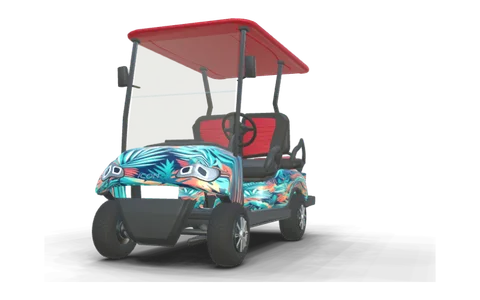
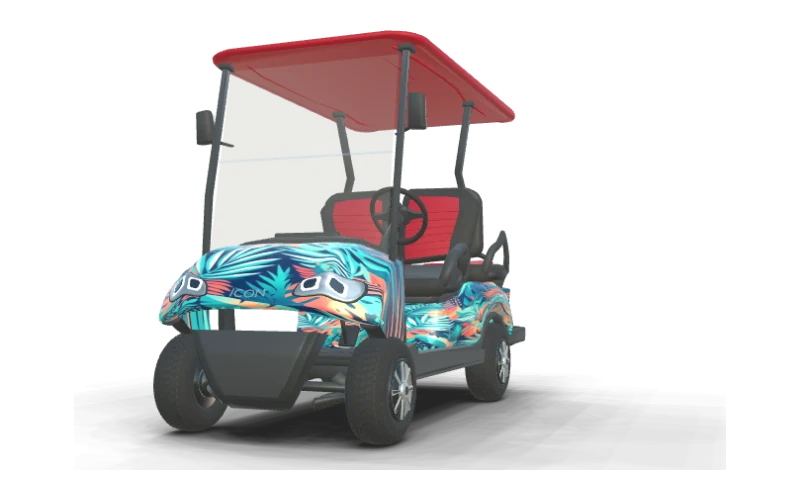
ICON i40 Standard Wrap
Standard, ride height, four seats, rear-facing second row
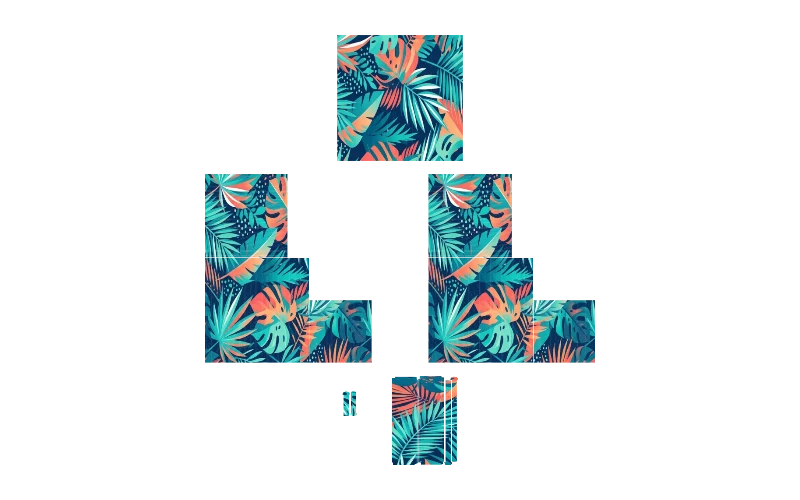
Explore Miami Palms on an ICON i40, then tune its colors or use it as a reference point for custom AI artwork.
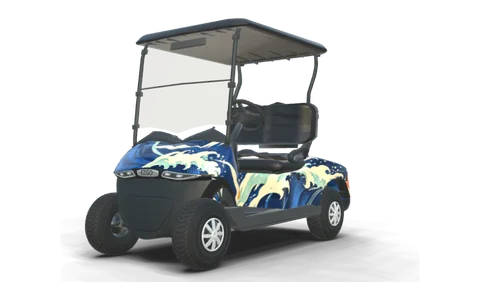
E-Z-GO RXV 2 Freedom ELiTE Lithium Wrap
Two, seats, Ocean Grey, black roof
Coastal Current shows how sweeping blue and white waves follow the compact E-Z-GO cowl and side skirts.
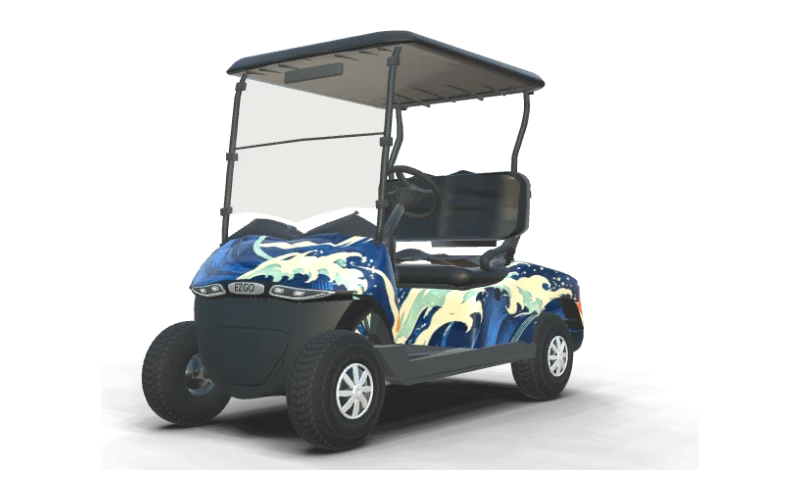
How Cart Make and Body Shape Change Color Balance
The same wrap colors read differently on an E-Z-GO, Club Car or Yamaha because each manufacturer sculpts its nose and side panels differently. Search demand reflects how make-specific owners are when shopping for wrap looks: Club Car and E-Z-GO lead monthly US wrap searches, followed closely by Yamaha.
Club Car Onward and Tempo bodies feature crisp, structured side contours and a sculpted cowl that frames bold two-tone stripes, patriotic stars and deep metallic colors cleanly. E-Z-GO TXT and Freedom RXV carts offer smooth, approachable side panels that wear sweeping coastal waves, geometric camo and clean decal strips effortlessly.
Yamaha Drive2 bodies carry sleek automotive-inspired curves that catch gloss highlights across the hood, making high-contrast navy, emerald green and vibrant tropical palms stand out immediately. Longer six-passenger stretched carts from ICON, Evolution and Bintelli add extra side skirt length where large-scale patterns shine without feeling cramped.
Pick your exact make and seating configuration in the 3D viewer before locking down colors. A high-contrast black-and-gold trim line that looks dramatic on a stretched four-seat lifted Onward may need slightly tighter proportions on a compact two-passenger E-Z-GO.
Notice how much unpainted frame plastic, dashboard bezel and fender flare each make leaves exposed. Lifted four-seat and six-seat carts often carry bold black fender flares over oversized tires, which naturally frame dark accents and tie right into matte black wheels or smoked windshields without requiring extra black artwork on the body panels.
Semrush US keyword data, October 2026 snapshot.
Match the Roof and Windshield to Your Wrap
Your roof canopy is a broad horizontal plane hovering right over the wrap, so it either calms the body or frames it dramatically. A white canopy brightens dark navy, emerald green and coral wraps while keeping the silhouette resort-friendly. A black canopy acts like a dark picture frame that sharpens red, white, teal or metallic gold artwork below.
Windshield tint controls how heavy the cabin feels from the front. Clear glass keeps the interior bright and lets white or tan seat upholstery become part of your visible palette. Light smoke introduces a cool gray transition that ties smoothly into silver wheels, while dark tint creates a bold black band beneath the canopy that pairs best with dark rims or black frame trim below.
Inspect the roof and windshield together from a front three-quarter angle rather than straight on. A black canopy paired with dark tinted glass makes a bright coral or white wrap pop aggressively, while a tan roof and light smoke screen settle an olive trail cart into natural earth tones.
Use the four build recipes below as reliable benchmarks, then swap one hardware setting at a time in the dock. Changing just the canopy from white to black often reveals immediately whether your wrap wants a crisp frame or an open coastal feel.
Pay special attention to roof struts and grab handles framing the cockpit. On most carts those supports stay matte black, so echoing black somewhere in your wheels, seat trim or lower body stripe makes the upright supports disappear smoothly into the overall silhouette rather than cutting awkwardly across a light palette.
Golf Cart Wraps 3D catalog hardware coverage, November 2026 (7 open-front classic models ship without a windshield mesh).
Coastal classic
Navy and white waves, gloss finish, white roof, clear windshield, white seats and machined silver wheels.
Tropical contrast
Coral and teal palms, gloss finish, black roof, light smoke windshield, black seats and matte black wheels.
Quiet trail
Olive and tan camo, matte finish, tan roof, light smoke windshield, saddle tan seats and bronze wheels.
Evening gold
Black body with gold lines, chrome accents, black roof, dark tinted windshield, black seats and gold rims.
Coordinate Seat Colors and Custom Wheels
Seats and wheels anchor opposite halves of the cart and finish every color story. Saddle tan marine seats warm up olive camo, fairway green and cream wraps instantly. Charcoal or black seats give bright coral, crimson and electric blue graphics a grounded center, while bright white seats complete breezy beach builds under a white canopy.
Seat piping and center inserts let you repeat your 10% accent color without overwhelming the cabin. Run crisp white piping across navy or black seats next to a coastal wrap, or add subtle tan stitching alongside woodland graphics. When the body wrap already carries intricate artwork, keeping the primary seat cushions solid stops the cabin from fighting the panels.
Wheel finishes control the visual weight around the tires. Matte black wheels put a clean, sporty edge beneath red, teal or bright yellow wraps without adding another hue. Bronze and satin gold rims warm up olive camo and black-and-gold cruisers, while machined silver alloy looks timeless with cool blues, grays and whites.
Orbit low near wheel level and high from standing eye level before finalizing your wheel and seat picks. Remember that black rubber tires already introduce a dark border around every wheel well, so repeating a touch of black in your frame trim or seat piping keeps dark tires looking intentional even on an all-white coastal cart.
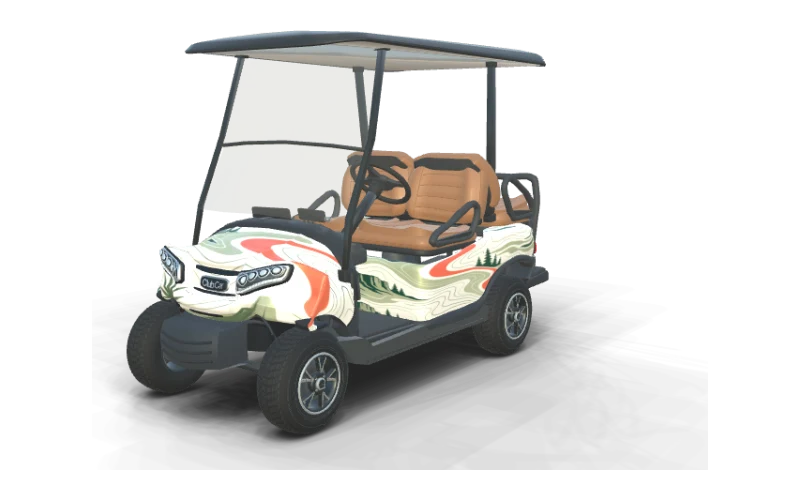
You do not need every part to wear the exact same color. Repeating one accent color twice across the cart, such as gold pinstripes on the side skirts echoed by bronze rims or seat piping, is enough to make the whole build click.
Use Factory Paint in Partial Wraps and Decals
Not every great cart needs edge-to-edge full coverage. If you already enjoy your factory paint, treat that stock body color as your 60% dominant base and design custom partial wraps, side stripes or tailored decals that work directly with it. That approach keeps the cart clean while giving it genuine personality.
Glacier white factory bodies accept almost any accent direction, from deep navy coastal waves and coral tropical silhouettes to bold patriotic flags and matte black geometric stripes. Matte black stock bodies turn crisp metallic gold lines, bright red racing accents or cool silver graphics into dramatic focal points with minimal coverage.
Fairway green and forest green stock carts shine with warm cream striping, saddle tan emblems or subtle botanical accents that honor the original color. Bright red carts already bring plenty of visual power, so crisp white and midnight navy stripes or clean gloss black graphics balance them far better than adding another loud primary shade.
Watch panel seams and edges whenever factory paint stays visible around a decal. A pale cream line that pops over dark paint disappears the moment it crosses a white accent strip. Set the cart base body paint inside the 3D Paint panel to match your actual factory color so every partial graphic gets judged against real contrast.
| Factory body color | Strong graphic colors | Accent finish to try | Seat and roof match |
|---|---|---|---|
| Glacier White | Deep navy, teal, coral or matte black | Gloss or holographic accents | White roof with navy or white seats |
| Matte or Jet Black | Warm gold, crisp white, crimson or neon lime | Chrome or satin metallic | Black roof with black or tan seats |
| Fairway Green | Cream, khaki tan, brushed gold or charcoal | Matte or subtle gloss | Tan roof with saddle tan seats |
| Silver or Slate Gray | Midnight navy, bright teal or matte black | Gloss or matte contrast | Black roof with charcoal seats |
Test Color Swaps and AI Design Variations
AI lets you test bold color directions in seconds instead of wondering how a palette might turn out. Pick your cart model, select color chips that express your palette, and describe the graphic mood in plain English. When words fall short, attach a photo of a coastal sunset, favorite fabric or matching boat so AI translates those exact tones onto your cart panels.
Name your color hierarchy right inside the prompt. Instead of typing "beach colors," ask for a deep navy base covering most of the panels, broad white rolling waves along both sides, and a thin coral pinstripe near the lower edge. Giving the AI clear dominance ratios produces cleaner, more usable first drafts.
Run controlled A/B tests by holding the motif steady while changing one color or finish. Compare gloss navy-and-white against matte teal-and-cream on the exact same cart with the exact same roof and seats. Orbit slowly under the studio lighting to verify that highlights and shadows flatter the artwork rather than flattening it.
Once a color direction clearly leads, layer your personal family name, cart number or club logo on top and inspect contrast around every letter. Use the three prompts below as starting blueprints and swap in your own preferred colors.
Save every strong finalist under a clear name like "Navy Gloss White Roof" or "Olive Matte Tan Seats" inside your account. Stepping away for ten minutes and viewing your top two builds back to back makes subtle balance flaws jump off the screen immediately.
Coastal navy and white
Create a coastal golf cart wrap with a deep navy base, broad white waves and a thin coral accent. Keep the shapes open and leave a clear area for a family name.
Produces
- A high-contrast coastal direction following the 60-30-10 balance.
Pitfalls
- Too many thin overlapping waves can make side lettering harder to read.
Olive trail camo
Design a matte olive and tan camo wrap for a golf cart. Use large irregular shapes, dark charcoal shadows and a quiet outdoor feel across the body panels.
Produces
- An earthy pattern built for tan seats and bronze wheels.
Pitfalls
- Small scattered specks blur together from street distance.
Black and gold
Create an understated black golf cart wrap with crisp gold geometric lines and a clean front cowl monogram area. Keep most panels dark and balanced on both sides.
Produces
- A tailored dark design with warm metallic direction.
Pitfalls
- Hairline strokes can vanish inside bright gloss reflections.
Check Every Angle and the Unfolded Sheet
Finish every color build with a structured review across both the 3D cart and the flat unfolded wrap sheet. Start zoomed out at street distance and verify that your eye spots three things in order: the dominant color mood, the primary graphic flow, and your accent or family name. If all three shout at equal volume, tone down one accent before exporting.
Spin cleanly through front, left, rear, right and high three-quarter views. Look closely at where side stripes cross wheel wells and how dark or light zones meet your bumper trim, roof struts and windshield tint. Check text from afar first so readability wins over tiny close-up flourishes.
Switch to the flat wrap sheet to inspect color balance across every panel at once. Check that left and right skirts stay symmetrical, that no important crest hugs a narrow panel margin, and that bright accents distribute evenly without leaving the front nose bare or overcrowded.
Compare your top contender against one cleaner, slightly simpler version. Nine times out of ten, the cart with disciplined contrast and coordinated hardware looks far more expensive than the busier draft. Once the full 3D cart and flat sheet align, unlock your watermark-free HD export and save the build to your account.
- 1Pick 2 or 3 colors (60-30-10)
- 2Generate AI wrap variations
- 3Test gloss, matte, chrome and holo
- 4Match roof, seats, wheels and tint
- 5Inspect 3D angles and flat sheet
- 6Export watermark-free in HD
Golf Cart Wrap Color and Finish Questions
Navy and white, coral and teal, matte olive and tan, and black and gold are proven palettes. Let one color carry roughly 60% of the body, back it with a 30% graphic or hardware color, and repeat one 10% accent cleanly.
Two or three main colors produce the cleanest look at street distance. You can still layer lighter and darker shades inside those color families while reserving your strongest contrast for the main motif or family name.
Gloss makes bright coastal, tropical and patriotic colors pop with crisp reflections, while matte softens glare and gives dark, camo and modern geometric wraps a tailored look. Preview both live on your 3D cart to see which fits your body curves.
Holographic adds an angle-shifting iridescent sheen as you move around the cart. It looks sharpest when paired with bold dark graphics and open negative space so the color shift frames the design rather than crowding it.
Yes. A black canopy creates a crisp upper frame over white, coral or teal body panels. Repeat black in the seats, bumper trim or matte black wheels so the lower half balances the dark roof.
Saddle tan seats pair naturally with matte olive because both sit in the same warm outdoor palette. Black seats deliver sharper modern contrast, and tan piping can echo a khaki accent from the wrap.
No. Wheels look strongest when they match the temperature or contrast of the palette rather than copying the exact body paint. Bronze warms up olive and black-and-gold wraps, while machined silver flatters cool blues and whites.
Clear glass keeps the cabin open and highlights light seat upholstery, light smoke softens bright trims, and dark tint creates a bold dark band under the roof that balances black wheels or dark lower bodywork.
Yes. Set the cart base color in the 3D Paint panel to your stock paint, then create custom partial wraps or decals with strong contrast against it. White paint carries navy or coral effortlessly, while green suits cream and tan.
Yes. Pick color chips and describe the look, or upload a reference photo, and AI generates custom wrap artwork directly onto your cart panels so you can compare finishes and hardware in 3D.
Sources
- Golf Cart Wraps 3D Catalog and Hardware Zone Coverage (34 models) (accessed 2026-11-21)
- Semrush US Keyword Magic Database (Club Car, E-Z-GO and Yamaha wrap cluster, October 2026 snapshot) (accessed 2026-11-21)
- E-Z-GO Personal Golf Cart Models and Paint Options (accessed 2026-11-21)
- Yamaha Drive2 Personal Transportation Vehicles (accessed 2026-11-21)
Golf Cart Wraps Team
Editorial team
We build the 3D golf cart wrap designer on this site and write practical guides on scaling patterns, placing decals and previewing panels before saving your design.
Find your ideal golf cart color combination
Open the Yamaha tropical design, explore custom AI color swaps, and match your roof, seats and wheels in 3D.
Start with tropical